Research Projects
WebMRT: An Online Tool to Predict Summertime Mean Radiant Temperature Using Machine Learning
08/2023 – 07/2024
WebMRT is an online tool that predicts summertime mean radiant temperature (Tmrt) using machine learning models trained on MaRTy data. It simplifies complex thermal exposure modeling, making it accessible for urban planners and climate decision-makers.
Publications
Saud R. AlKhaled, Ariane Middel, Pouya Shaeri, Isaac Buo, Florian A. Schneider, WebMRT: An online tool to predict summertime mean radiant temperature using machine learning, Sustainable Cities and Society, Volume 115, 15 November 2024, 105861.
Pouya Shaeri, Saud AlKhaled, Ariane Middel. A Multimodal Physics-Informed Neural Network Approach for Mean Radiant Temperature Modeling, arXiv preprint, arXiv:2503.08482, 2025.
Cool Routes
ASU Cool Routes is a web tool that identifies walking routes on ASU’s campus with lower Mean Radiant Temperature (MRT) to improve thermal comfort. It simulates and compares cooler paths versus shortest paths using hourly MRT forecasts and LIDAR-based surface models.
MaRTiny
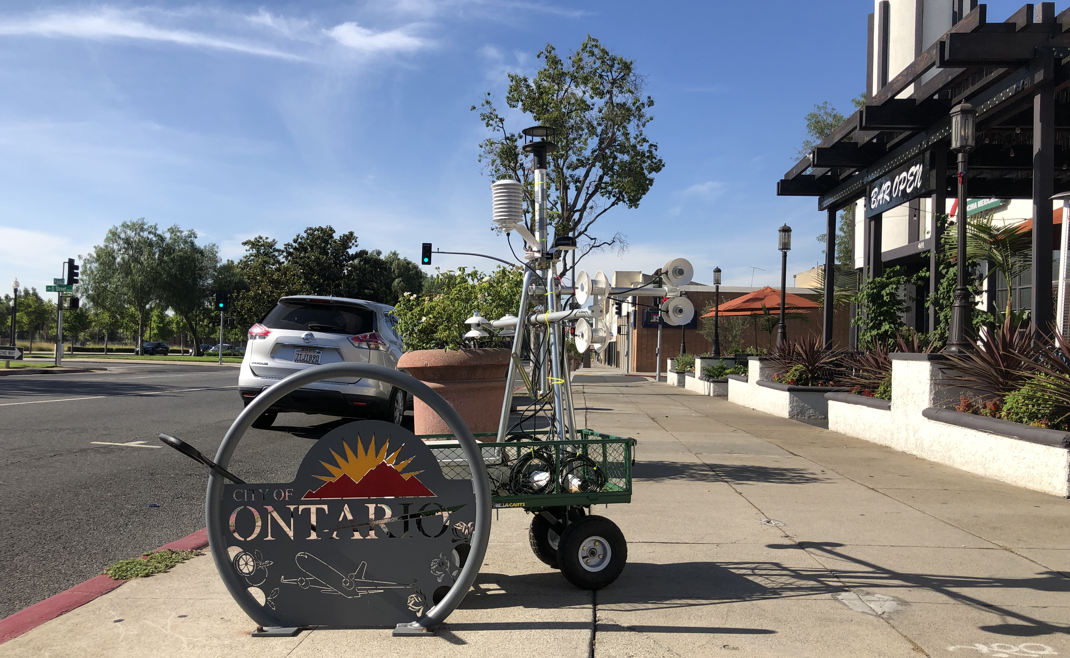
MaRTiny is a low-cost, compact, solar-powered environmental sensing device designed for real-time urban climate monitoring. It measures air temperature, humidity, wind speed, solar radiation, UV, and globe temperature to support research on thermal comfort and heat exposure in outdoor environments.
Publications
Karthik Kashinath Kulkarni, Florian A. Schneider, Tejaswi Gowda, Suren Jayasuriya, Ariane Middel. (2022). MaRTiny – A low cost thermal sensing device, Frontiers in Environmental Science, 10:866240.
OpenMRT
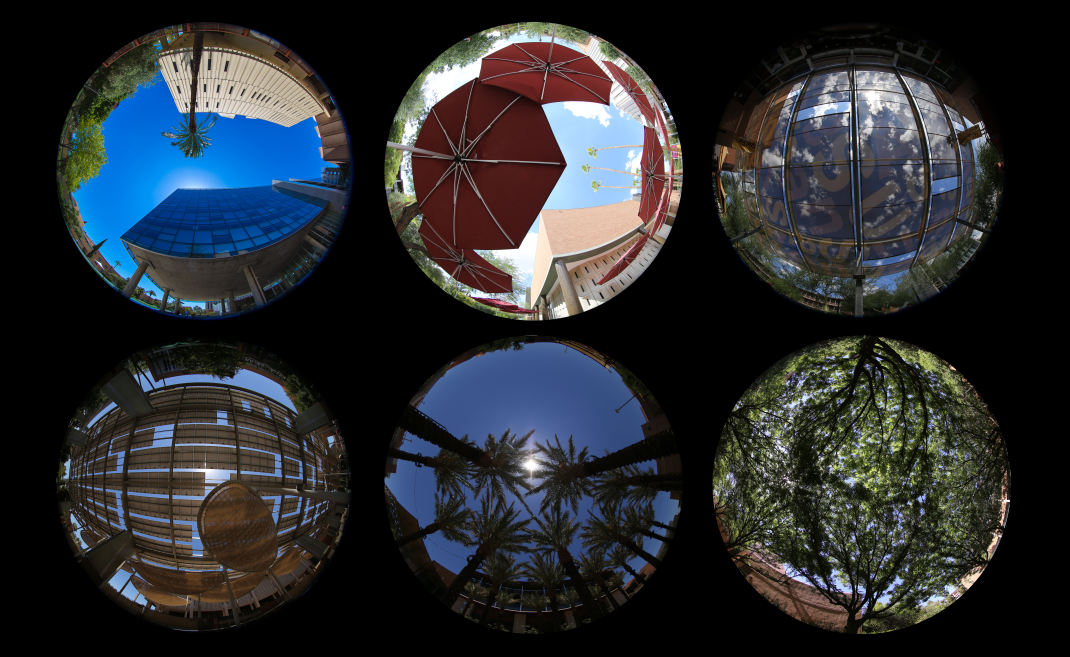
OpenMRT is a modeling framework that estimates Mean Radiant Temperature (MRT) using six-direction images and environmental data. It simulates radiation exchange in urban settings to assess outdoor thermal comfort and heat exposure.
PanoMRT
PanoMRT models human thermal exposure and comfort using 360° panoramic infrared images and weather data to calculate MRT, PET, and UTCI. It captures spatially detailed surface temperatures to improve longwave radiation estimates, especially in shaded urban environments.
Publications
Ariane Middel, Matthew Huff, E. Scott Krayenhoff, Ananth Udupa, Florian A. Schneider. (2023). PanoMRT: Panoramic infrared thermography to model human thermal exposure and comfort, Science of the Total Environment, 859:160301
SHaDE Tool
SHaDE Tool is an interactive platform that estimates human thermal comfort using fisheye sky images, ground cover, and shade characteristics. It allows users to simulate solar exposure and evaluate the cooling effectiveness of different shade configurations.
The Right Shade for the Right Place
07/2019 – 06/2020
Sponsored by the Healthy Urban Environment Initiative (HUE), Arizona State University, in collaboration with City of Tempe
Publications
Florian A. Schneider, Ariane Middel, Saud AlKhaled, Björn Hagen, Paul Coseo, 50 Grades of Shade – Assessment of engineered and natural shade in hot dry communities. EGU General Assembly 2019, Vienna, Austria, April 7–12, 2019.
Bjoern Hagen, Saud AlKhaled, Paul Coseo, Ariane Middel, 50 Grades of Shade – Assessment of engineered and natural shade in hot dry communities, 10th International Conference on Urban Climate (ICUC-10), New York, August 6–10, 2018.
News
NPR Here & Now (September 2019): Phoenix Residents Will Need To Adapt To An Even Hotter Climate
Fox 10 News (September 2019): ASU professor studies how different types of shade can help keep us cool in the heat

Health Impact Project
07/2019 – 02/2020
Sponsored by the PEW Charitable Trust, in collaboration with City of Tempe
A Simulation Platform to Enhance Infrastructure and Community Resilience to Extreme Heat Events
08/2016 – 07/2020
Sponsored by the National Science Foundation's Infrastructure Management and Extreme Events Program (Award No. 1635490)
Transformative Climate Communities
05/2019 – 04/2020
Sponsored by the UCLA Luskin Center